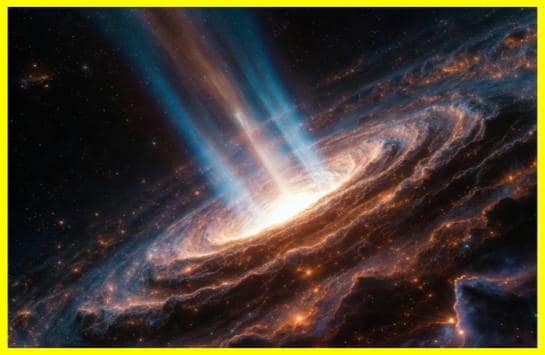
Supermassive Black Hole in the Early Universe Grows 13 Times Faster Than the Eddington Limit
This remarkable finding, made by a team of Japanese researchers using the Subaru Telescope, fundamentally questions long-standing theories about how black holes and quasars formed and evolved in the young Universe.
What Exactly Did Scientists Discover?
An international research team led by scientists from Waseda University and Tohoku University in Japan identified a rare quasar located roughly 12 billion light-years away. This means we are seeing the object as it appeared when the Universe was less than 1.5 billion years old.
At its core, the supermassive black hole is rapidly consuming surrounding matter at a rate that exceeds the Eddington limit by a factor of 13—a theoretical boundary where radiation pressure should halt further accretion. Remarkably, the object also shines brightly in X-rays and produces strong radio emissions from a relativistic jet.
Such a combination of properties was considered highly unlikely under most existing models of black hole accretion. Typically, super-Eddington growth phases suppress X-ray coronae and jet activity.
How Were the Observations Conducted?
The breakthrough was enabled by the MOIRCS infrared spectrograph on the Subaru Telescope located on Mauna Kea, Hawaii.
Researchers analyzed gas motion near the black hole using the Mg II emission line to estimate its mass, while complementary X-ray data confirmed the extreme accretion rate.

Why Is This Discovery Significant for Astrophysics?
The Eddington limit represents a key physical constraint on how quickly black holes can grow. Overcoming this barrier in the early Universe helps explain how supermassive black holes with billions of solar masses could emerge so soon after the Big Bang.
Experts suggest this quasar is in a transient super-Eddington phase, possibly triggered by massive gas inflows from galaxy mergers or dense clouds. It offers a unique window into dynamic processes that were common in the cosmos’s youth.
The findings were published in The Astrophysical Journal (DOI: 10.3847/1538-4357/ae1d6d). This discovery advances our understanding of galaxy evolution, the role of jets in feedback mechanisms, and the rapid formation pathways of supermassive black holes.
Conclusion
This groundbreaking observation by Japanese astronomers reveals that physical conditions in the early Universe were far more extreme than previously thought.
Future studies of similar objects will further unravel the mysteries behind the birth and growth of the Universe’s largest black holes.
Sources: Waseda University, National Astronomical Observatory of Japan, The Astrophysical Journal (2026).
