Pharos Lighthouse Fragments Recovered from the Sea Near Alexandria: One of the Seven Wonders Returns
Archaeologists recently raised enormous stone blocks from the Mediterranean seabed off the coast of Alexandria — pieces belonging to the legendary Pharos Lighthouse (also known as the Lighthouse of Alexandria), one of the Seven Wonders of the Ancient World.
This remarkable find represents a major breakthrough in efforts to piece together the story of a structure lost to history for centuries.
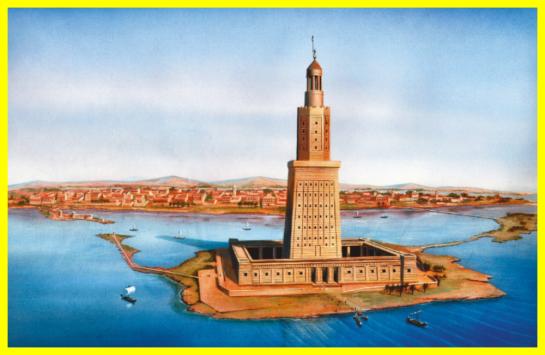
The History of the Lighthouse of Alexandria
Constructed on the island of Pharos in the 3rd century BC under Ptolemy II Philadelphus, the Pharos Lighthouse stood approximately 130–140 meters tall, making it one of the tallest man-made structures of the ancient era.
It guided ships safely into Alexandria’s busy harbor and served as a powerful symbol of Hellenistic Egypt’s engineering prowess and cultural dominance.
The tower endured multiple earthquakes over the centuries but was finally destroyed by devastating tremors in the 14th century. Its remains sank to the bottom of the harbor, where they lay undisturbed for more than 600 years.
VIDEO. The Lighthouse of Alexandria | The Tallest Ancient Tower.
A Groundbreaking Underwater Discovery
As part of the ongoing Franco-Egyptian PHAROS project, led by archaeologist Isabelle Hairy, divers and researchers successfully recovered 22 massive granite and limestone blocks from the seafloor. Each block weighs between 70 and 80 tons.
The haul includes lintels and jambs from monumental gates, threshold stones, foundation slabs, and previously unknown sections of a pylon.
Of particular interest are the entrance elements that blend characteristic ancient Egyptian construction techniques with Hellenistic Greek influences. These artifacts offer fresh insights into the lighthouse’s sophisticated architectural design.
The PHAROS Project: Bringing an Ancient Wonder Back to Life
The primary goal of the PHAROS project is to produce the most accurate 3D digital reconstruction possible of the Pharos Lighthouse.
Over recent years, thousands of submerged fragments have been scanned in situ. Lifting the largest blocks to the surface now allows detailed laboratory analysis and precise modeling.
Supported by Egypt’s Ministry of Tourism and Antiquities and leading French research institutions, the initiative harnesses cutting-edge technology to virtually resurrect the lighthouse.
This work continues to uncover new details about one of the Seven Wonders of the Ancient World.
The recovery of these Lighthouse of Alexandria fragments is both a scientific triumph and a vivid reminder of the ingenuity of ancient engineers. With the PHAROS project still underway, a complete digital revival of this iconic wonder is on the horizon.