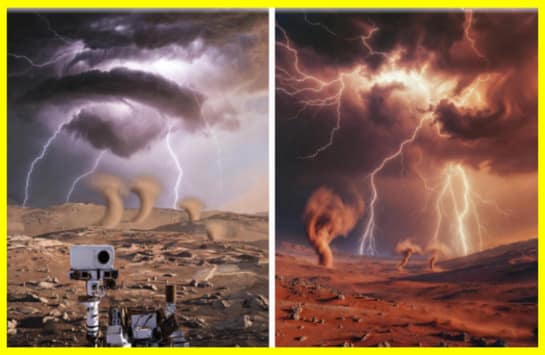
Scientists First Ever Recorded the Sound of Electric Sparks in the Atmosphere of Mars
The signals were accidentally captured by the SuperCam microphone — the only working microphone on the surface of the Red Planet — aboard NASA’s Perseverance rover.
The results of this groundbreaking discovery have been published in the prestigious journal Nature (2025).
How Perseverance “Heard” Martian Lightning
Originally designed to record wind sounds, rover movements, and laser shots on rocks, the SuperCam microphone unexpectedly found itself in the middle of two powerful Mars dust devils (Martian dust whirlwinds).
During these events, scientists from Toulouse and Paris noticed unusual acoustic and electromagnetic pulses in the recordings.
After detailed analysis, the team confirmed: these were real miniature electric discharges — similar to the weak static shocks people feel on Earth when touching a metal doorknob in dry weather.
Why Sparks Appear So Easily on Mars
When the tiniest particles of Martian dust rub against each other inside a dust devil, they become electrically charged through triboelectric effect.
Mars’ atmosphere is extremely thin — about 100 times less dense than Earth’s — so the voltage required to create a spark is dramatically lower.
As a result, accumulated charges discharge in the form of tiny centimeter-long sparks. Each spark generates a faint shock wave — a barely audible “pop” that was perfectly captured by the sensitive SuperCam microphone.
Why This Discovery Matters
This is the first direct evidence of static electricity discharges occurring naturally on Mars. Previously, such processes were only predicted by computer simulations.
The finding highlights the enormous potential of planetary acoustics: microphones can detect phenomena invisible to cameras — from wind turbulence characteristics to hidden electrical processes inside dust storms.
Published: Nature, 2025
Lead institutions: University of Toulouse and Paris Cité University (France), with participation of NASA and international teams.
This discovery not only deepens our understanding of the Martian atmosphere, but also has practical implications: strong electric discharges in global dust storms could pose a real risk to future human missions and equipment on the Red Planet.
